kimi delta attn from first principles
+ linear attention, delta net, and gated delta net
some reference material:
https://arxiv.org/pdf/2510.26692
https://haileyschoelkopf.github.io/blog/2024/linear-attn/
The idea is to have a small memory matrix to continuously learn and forget information as it arrives. KDA builds upon linear attention, DeltaNet and gated DeltaNet and adds fine-grained gating mechanism
Let’s go from first principles.
Self attention
What’s wrong with regular softmax attention?
- in self attention the query is compared against ALL previous keys
- but this is quadratic - scales to $O(n^2)$
- the KV cache also grows at $O(N)$ with every new token
- this is not very efficient for fast inference and takes up a lot of memory especially for long context tasks
- it would be ideal if we can compress the KV cache to a fixed size memory and perform attention at linear time (instead of quadratic)
Linear Attention
To linearize attention, we can replace softmax with a similarity function
- we can use the multiplicative associative property and rearrange the multiplication from $(QK)V$ to $Q(KV)$
- this makes it linear
- because changing the order of matrix multiplication means we never have to construct the $N\times N$ attention matrix
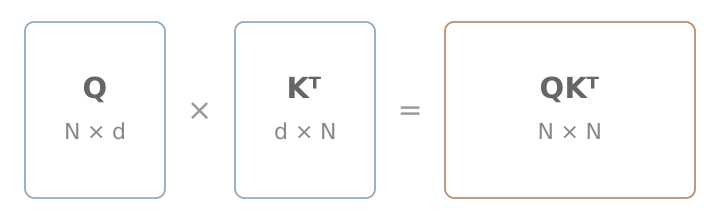
- this gives us $O(N^2d)$ - quadratic
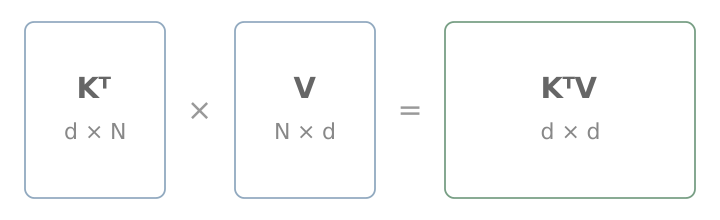
- this gives us $O(Nd^2)$ - linear
- We can’t do $Q^\top K$ of course because then this gives us feature correlations instead of token scores
Why can’t we just reorder this in self attn?
- We can’t simply change this multiplicative order in softmax attention though because softmax is non-linear
- and in causal attention we can’t compute $K^\top V$ because then tokens can see all future tokens too
- so for causal linear attention we keep a running state of the linearized attention
- $S_t$ is introduced as a memory matrix that stores
- recurrent state
- this is way faster to compute than regular self attention
- does not require softmax
Associative memory
- $S_t$ is an associative memory between keys and values.
- associative memory is a mapping between two things (Alex → blue) etc.
- but if two key vectors are the same, this causes memory interference
So what’s wrong with Linear attention?
- the recurrent formula $S_t=S_{t-1}+k_tv_t^\top$ only learns to update the $S_t$ memory matrix with new information
- it does not remove old or outdated associations
- this brings us to the delta rule
DeltaNet
- delta net uses the delta rule to update the memory matrix $S_t$
- instead of continually updating KV pairs into memory, it first checks what the current memory predicts for a given key, and computes a delta between the prediction and the actual value.
- from memory with previous tokens, $S_{t-1}$, we find the predicted value from current key
- we also have the current value $v_t$, using this find the error
- now we update the memory using this error. $\beta_t$ is a learnable param and it controls how strongly the memory is updated
Online gradient descent on a reconstruction objective:
- so say we define the reconstruction loss as: (which is the mean square error)
- in gradient descent we differentiate the loss function wrt to $S$
- the update rule becomes:
- you can substitute the loss term ($\nabla_S\mathcal{L}_t$) to get
- which is equal to
- so the memory update rule can be interpreted as an online gradient descent on the reconstructed loss- during inference, the DeltaNet memory $S$ weights are dynamically updated for each token, called fast weights.
Gated DeltaNet
- so far delta net attention learns to update/overwrite memory, but it can’t forget redundant memory yet - gated deltanet solves this
- gated DeltaNet adds a scalar forget gate to the update rule
- where $\alpha_t$ is a form of weight decay on the fast weights
Problems with GDN
- the problem here is that GDN uses a single scalar $\alpha$ for the entire memory matrix of a head.
- which means that every row of the matrix (each row corresponds to a key feature vector) gets forced to the same forget gate
- some rows may contain memory that need to persist longer than the others - we need fine-grained gating
- fixing this was the motivation for kimi delta attention
KDA
- improves the delta rule with fine-grained gating
- it replaces the single scalar forget gate $\alpha$ with a vector of forget gates, one forget gate per row
- KDA applies $\operatorname{diag}(\alpha)$
Breaking down the KDA equation from the paper:
- Each row of the memory matrix $S$ gets its own decay factor to forget memory
$$\bar{S}_t=\operatorname{Diag}(\alpha_t)S_{t-1}$$
- starting with the delta net update rule
$$S_t=S_{t-1}+\beta_t k_t(v_t-S_{t-1}^\top k_t)^\top$$
- can be expanded to
$$S_t=S_{t-1}+\beta_t k_t v_t^\top-\beta_t k_t k_t^\top S_{t-1}$$
- factor out $S_{t-1}$ using an identity matrix $I$
$$S_t=(I-\beta_t k_t k_t^\top)S_{t-1}+\beta_t k_t v_t^\top$$
- putting this together we get the KDA equation
- can be expanded to
KDA has three gates actually, forget gate $\alpha_t$, update gate $\beta_t$ and output gate $g_t$:
- while computing attention, just like how $Q$, $K$, $V$ matrices are projected from the input hidden state, $\alpha$ and $\beta$ gates are also projected from the input hidden state
- the $\alpha$ and $\beta$ weights are learned during the model’s pretraining
- to compute $\alpha$ projection we have an up projection and a down projection
- to produce the decay vector $\alpha$:
- a low-rank projection is used
- and for the update vector $\beta$
- we apply sigmoid (since $\beta$ is a scalar value) to normalize it to be between $[0,1]$
- only the memory matrix $S_t$ (the fast weights) are learnt during inference through online gd
- this does not need backprop or an optimizer
- and then the resulting memory matrix is multiplied by the queries to get the output
- KDA also introduces an output gate
- RMSNorm applied to $o_t=S_t^\top q_t$
- then perform elementwise multiplication between output gate and the output $y_t$
- the output gate is to control how much of the attention result is passed on to the next layers
What is low rank parameterization:
- the forget gate $\alpha_t$ and output gate $g_t$ both use low rank parameterization
- typically we’d have one large learnable matrix, but in this case if $W_\alpha$ was $2048\times1024$, that’d be ~2 million params to compute just for a forget gate
- to make it more efficient we can split that into two smaller matrices
- compress the input 1024 to 128 (low rank) using the down proj and expand to 2048 using up proj
- this uses far fewer parameters
KDA Architecture:
- To further improve the expressiveness of Kimi linear they add several changes to the attention architecture
- instead of computing $q=W_qx_t$, $k=W_kx_t$ and so on, they add:
- short conv - to include nearby tokens
- swish - for nonlinearity. without nonlinearity consecutive projections can collapse into a single projection
- L2 norm - $QK$ vectors are normalized so that magnitudes don’t grow too large
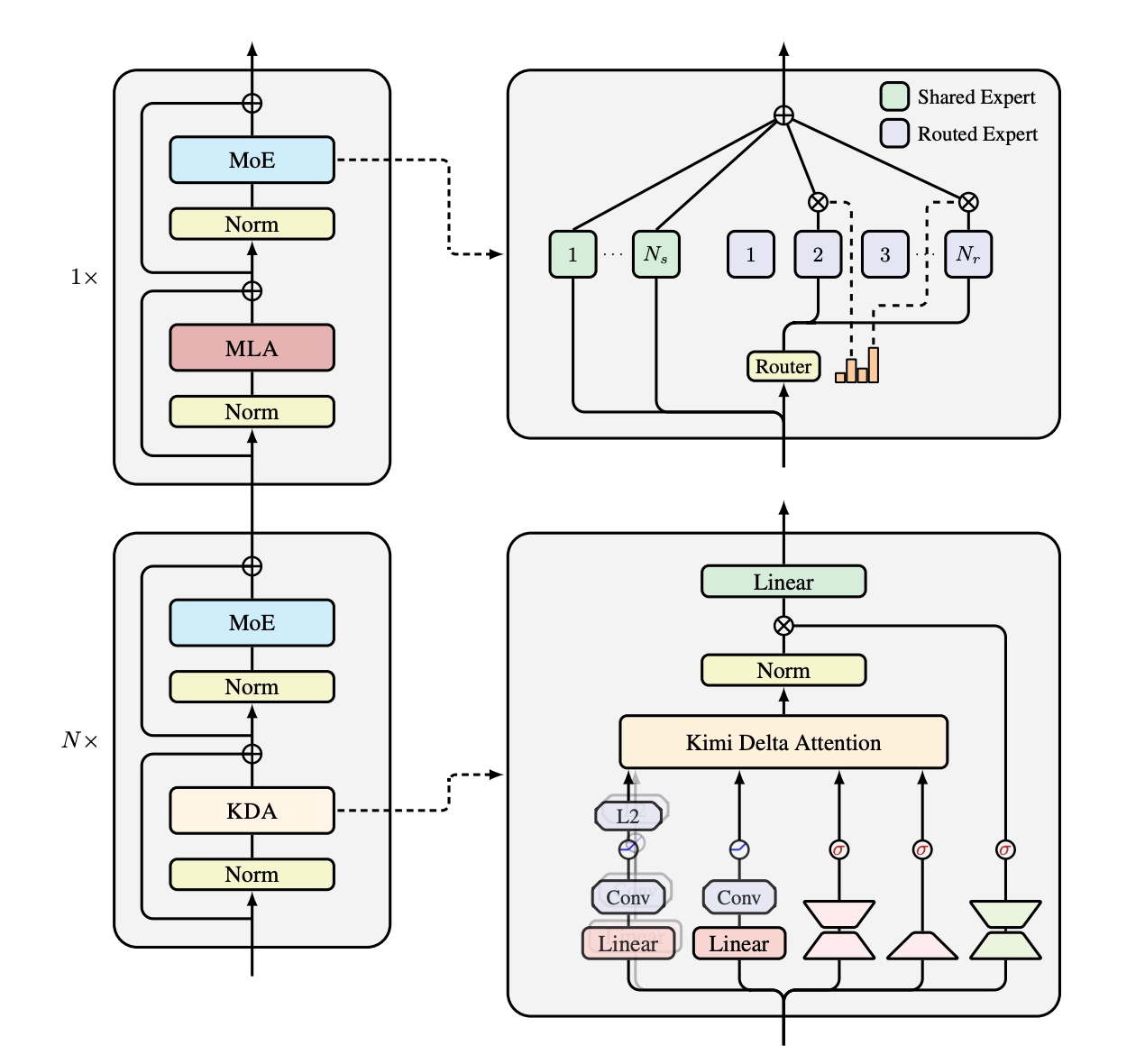
- kimi linear uses hybrid attention with a 3:1 ratio - repeating 3 KDA layers and 1 MLA layer
- NoPE for MLA, so KDA is responsible for all positional encodings
- the paper says that global NoPE attention with dedicated position aware attention yields better long context performance